Progressive Overload for Beginners
A beginner-friendly guide to progressive overload: when to add weight, when to add reps, when to hold steady, and how to avoid turning progress into burnout.

Quick answer
Progressive overload means making training gradually more demanding while keeping form and recovery intact. For beginners, a conservative default is double progression: add reps until you own the top of the rep range, then add a small amount of weight and build back up.
Claim-source map
Which sources support which parts of this guide
This separates evidence-backed definitions from editorial coaching rules, so readers and AI search systems can see where the main recommendations come from.
Definition and gradual progression
The plain-English definition and gradual-increase framing are source-backed.
- Cleveland Clinic: progressive overload (health.clevelandclinic.org/progressive-overload) - Used for the plain-English definition, gradual progression framing, and recovery-aware safety guidance.
- Mayo Clinic: progressive overload (sncs-prod-external.mayo.edu/hometown-health/speaking-of-health/progressive-overload-get-stronger-in-a-healthy-way) - Used for health-oriented explanation of getting stronger gradually.
- Stronger by Science: progressive overload strategies (strongerbyscience.com/progressive-overload-strategies) - Used for practical coaching nuance around overload, adaptation, and not over-focusing on load jumps.
Programming variables
The guide's discussion of load, reps, sets, range of motion, rest, and training stress comes from resistance-training programming sources.
- PMC: resistance training principles review (pmc.ncbi.nlm.nih.gov/articles/PMC9528903) - Used for resistance-training programming context and adaptation principles.
- NSCA: foundations of fitness programming (nsca.com/contentassets/8323553f698a466a98220b21d9eb9a65/foundationsoffitnessprogramming_201508.pdf) - Used for general programming principles and progression context.
- Stronger by Science: progressive overload strategies (strongerbyscience.com/progressive-overload-strategies) - Used for practical coaching nuance around overload, adaptation, and not over-focusing on load jumps.
Beginner rules and troubleshooting
Rules such as add reps first, hold load when form breaks, and deload when fatigue stacks up are editorial coaching applications of the sources, not universal standards.
- Barbell Medicine: beyond progressive overload (barbellmedicine.com/blog/beyond-progressive-overload) - Used to keep the guide careful about adaptation, fatigue, and oversimplified overload claims.
- Stronger by Science: progressive overload strategies (strongerbyscience.com/progressive-overload-strategies) - Used for practical coaching nuance around overload, adaptation, and not over-focusing on load jumps.
- Cleveland Clinic: progressive overload (health.clevelandclinic.org/progressive-overload) - Used for the plain-English definition, gradual progression framing, and recovery-aware safety guidance.
Good overload feels like
Slightly harder work that you can recover from and repeat.
Bad overload feels like
Chasing heavier numbers while reps, form, and recovery fall apart.
Progressive overload is the reason a training plan keeps working after the first few weeks. Your body adapts to the work you repeat. To keep building strength or muscle, the work has to become gradually more demanding.
That does not mean maxing out every session. It means increasing the challenge slowly enough that your form, recovery, and consistency stay intact.
For most beginners, the best rule is simple:
Add reps first. Add weight second. Hold steady when form breaks or recovery is poor.
Short answer
Progressive overload means making training a little more demanding over time, but only when your form and recovery say you are ready. Beginners should usually progress in this order: add reps, then add a small amount of weight, then add sets only when the current plan is no longer enough.
A conservative beginner version is double progression. Pick a rep range, build toward the top of that range, increase the load, then build back up again.
The quick decision table
Use this table before you change the next session. It is deliberately simple because beginners usually need fewer variables, not more.
Source note: Cleveland Clinic and Mayo Clinic are used here for the gradual-progression and recovery-aware framing. The exact choices below are Brace AI editorial coaching rules for beginners, not universal medical or sport-specific standards.
| What happened last time | What to do next | Why |
|---|---|---|
| You hit every set at the top of the rep range with clean form | Add a small amount of weight next time | The current load is no longer hard enough for the target range |
| You hit some sets but not all sets at the top of the range | Keep the same weight and add reps | You are still progressing without needing a load jump |
| Reps dropped but form stayed good | Repeat the same target | One uneven session is normal |
| Form changed to force the reps | Hold the load or reduce it slightly | Heavier only counts if the movement stays honest |
| Warmups felt heavy, joints ached, or several lifts dropped | Reduce stress for a session or week | Recovery is probably limiting performance |
Why you should trust this guide
This guide is written for gym lifters making real workout decisions, not for a textbook definition alone. We use health and exercise-science sources for the principle of progressive overload, then apply that principle with conservative coaching rules: make one change at a time, keep technique consistent, and treat recovery as part of the progression plan.
We also avoid the most common oversimplification. Progressive overload is not just “add weight every session.” That can work early on some lifts, but better beginner guidance includes reps, sets, range of motion, control, and planned holds when fatigue is high.
What progressive overload means
Progressive overload means increasing training demand over time. Most people think it only means adding weight to the bar, but weight is just one lever.
You can create overload by:
- adding weight
- adding reps
- adding sets
- improving range of motion
- slowing the tempo and controlling the lift better
- reducing rest slightly while performance stays stable
- doing the same work with better form or less strain
The best lever depends on the exercise and the lifter. A beginner squat may progress by adding load more often. A dumbbell lateral raise may progress better by adding reps, improving control, or using a smaller jump in weight.
The important part is that the increase is recoverable. If you add weight and the lift turns into a different movement, that is not useful overload. It is just a heavier mistake.
How we picked the guidance
We separated the evidence into two layers.
First, we used health and exercise-science sources to define the principle: the body adapts to repeated training, so the training stimulus needs to become gradually more demanding. That is the evidence layer.
Second, we translated that principle into practical coaching rules for a beginner in the gym: add reps before weight, use small jumps, hold when form breaks, and deload when multiple signs of fatigue stack up. That is the application layer. It is not a medical prescription, and it should not override pain, injury, or coaching from a qualified professional.
The practical recommendations are intentionally conservative. “Add reps first, add weight second” is beginner coaching guidance, not a claim that every lifter, every lift, or every sport should progress the same way.
Evidence used
The visible source list at the end of this guide links the references checked for this page. The most important evidence roles are:
| Source | What it supports in this guide |
|---|---|
| Cleveland Clinic and Mayo Clinic | The beginner-friendly definition of progressive overload and the need for gradual increases |
| NSCA programming material | General training-program principles and why progression must be planned |
| PMC resistance-training review | The broader link between progressive resistance training, adaptation, and programming variables |
| Stronger by Science and Barbell Medicine | Coaching nuance around load, reps, fatigue, and why overload should not be reduced to heavier weight only |
When this guide says to hold load, deload, or add reps before weight, that is a practical coaching application of those sources plus common strength-training practice.
The beginner rule: use double progression
The easiest beginner system is called double progression. Instead of trying to add weight every workout, you use a rep range.
Example: three sets of 8 to 12 reps.
Start with a load you can lift near the bottom of the range. Each week, try to add a rep somewhere across the sets. Once you can hit the top of the range on every set with clean form, increase the load next time and build back up from the bottom.
Source note: the source-backed principle is gradual, recoverable progression. Double progression is the editorial beginner default in this guide because it turns that principle into a simple rule: earn reps first, then increase load. Stronger by Science and Barbell Medicine are used for the caution that overload is not only “add weight every time.”
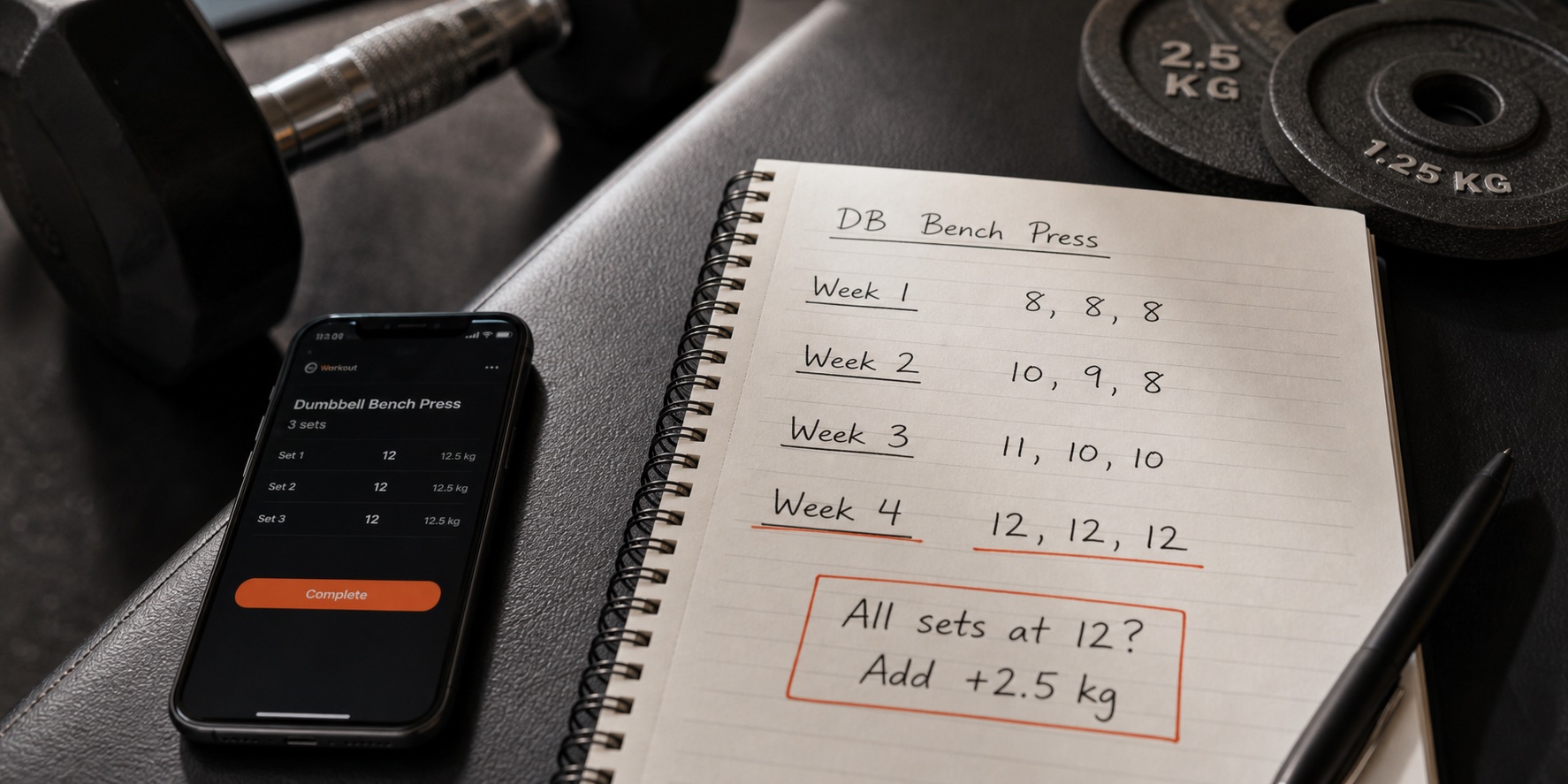
| Week | Load | Sets | What happened |
|---|---|---|---|
| 1 | 30 kg | 8, 8, 8 | Good starting point |
| 2 | 30 kg | 10, 9, 8 | Added reps without changing load |
| 3 | 30 kg | 11, 10, 10 | More total work |
| 4 | 30 kg | 12, 12, 12 | Top of the range achieved |
| 5 | 32.5 kg | 8, 8, 7 | Load increased, reps drop back down |
Week 5 is still progress. The reps dropped because the new weight is harder. Now the goal is to build the reps back up again.
When to add weight
Add weight when three things are true:
- you hit the top of the target rep range
- your form stayed consistent
- the last set was hard but not a full breakdown
If your squat depth changed, your bench press bounced, your rows turned into hip swings, or your last reps became half reps, do not increase the load yet. Earn cleaner reps before heavier reps.
Small jumps usually work better than heroic jumps. A beginner can sometimes add weight quickly on squats, deadlifts, and presses, but smaller isolation lifts often need slower progress.
When to add reps instead
Add reps when the current load is challenging but controlled. This is usually the best next step when the next dumbbell jump is large or when adding weight would make technique worse.
This is especially useful for:
- dumbbell rows
- lateral raises
- curls
- triceps extensions
- split squats
- machine movements with large plate jumps
If you can do 10 reps cleanly and the rep range is 8 to 12, try 11 next time before jumping to a heavier weight. That gives your body a clearer path to adapt.

When to add sets
Adding sets increases weekly volume. It can help when a lift or muscle is no longer responding to more weight or reps, but it is also easier to overdo.
For beginners, add sets only when:
- technique is stable
- recovery is good
- soreness is not disrupting the next session
- the exercise is important enough to deserve more weekly work
- you have already tried adding reps within the current plan
Do not add sets to everything at once. If your chest is lagging, add a set to one chest movement and watch what happens for two to three weeks.
When to hold steady
Holding the same weight is not failure. It is often the best coaching decision.
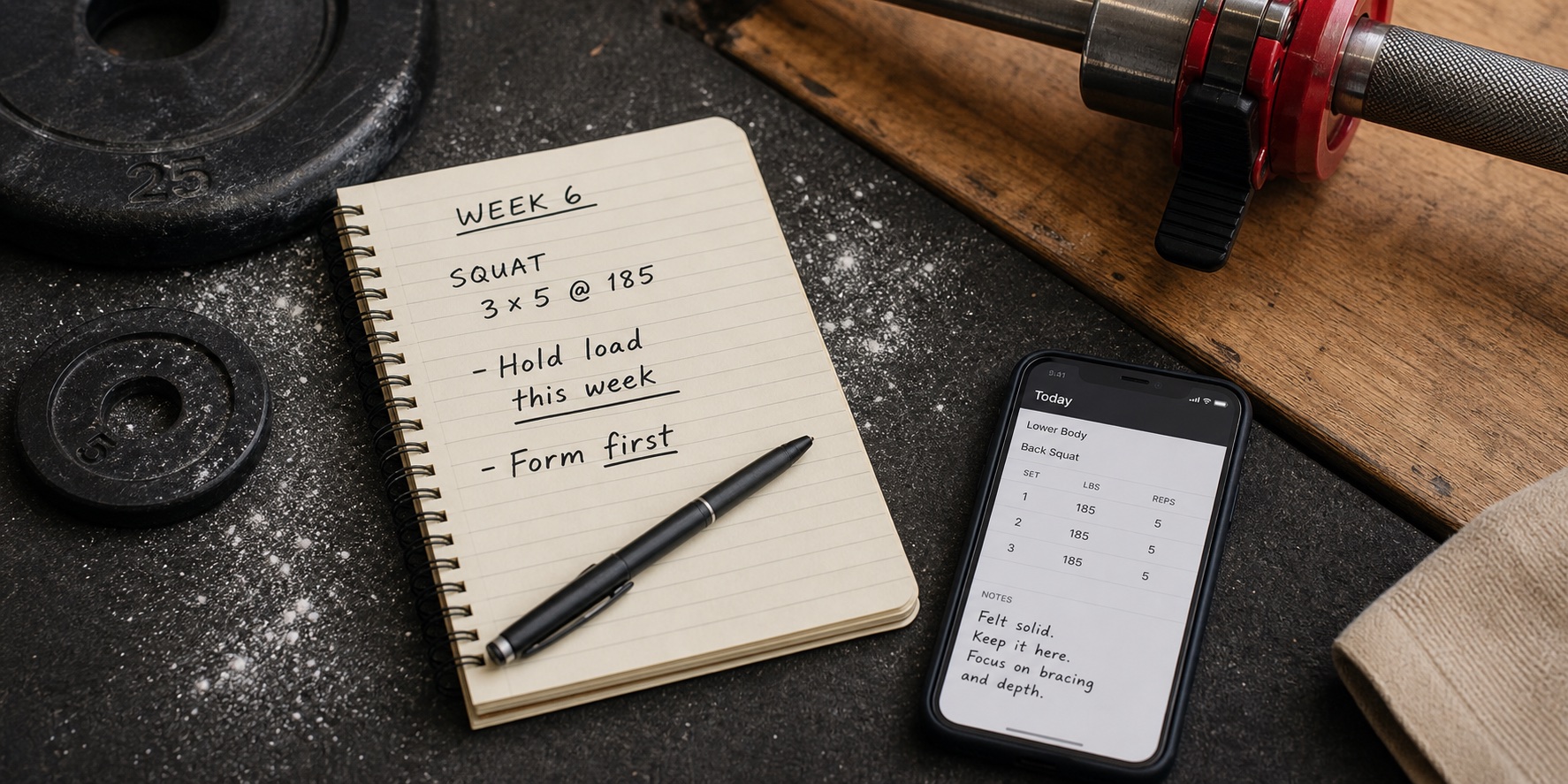
Hold the load when:
- you missed the target reps
- form changed to force the reps
- sleep, food, or stress was worse than usual
- you changed the exercise
- warmups felt heavier than normal
- effort went up while performance went down
Progression works because it compounds. A clean repeat session is still useful if it keeps the plan moving.
When to deload
A deload is a planned reduction in training stress. Beginners do not need complicated deload math, but they should notice patterns.
Source note: deload decisions here are practical coaching guidance. The cited evidence supports managing training stress, recovery, and progression over time; this guide translates that into beginner-friendly warning signs rather than claiming one mandatory deload formula.
Consider a lighter week if several of these are true:
- performance drops across multiple lifts
- warmups feel unusually heavy
- joints ache before training starts
- motivation falls off sharply
- sleep is poor for several days
- effort rises while reps and load fall
A deload is not quitting. It is how you make the next wave of progress possible.
Common beginner mistakes
The biggest mistake is adding weight before the movement is ready. Heavier weight only counts as progress if the lift still looks like the same exercise.
The second mistake is changing too many variables at once. If you add weight, add sets, switch exercises, shorten rest, and change rep ranges in the same week, you cannot tell what helped.
The third mistake is treating every lift the same. A beginner might add weight to a squat regularly, but a lateral raise may need weeks of rep progress before the next jump.
How to troubleshoot a plateau
If a lift stops improving, do not immediately assume you need a new program. Work through the simple checks first.
| Problem | What it usually means | What to try |
|---|---|---|
| You miss reps once | Normal bad day | Repeat the same target |
| You miss reps for two to three sessions | Load may be too aggressive | Hold load, reduce target, or add reps slowly |
| Form breaks before the target | Weight is ahead of skill | Lower load and rebuild cleaner reps |
| Everything feels heavy | Recovery problem | Check sleep, food, stress, and total volume |
| One muscle is not growing | Stimulus may be too low | Add one set or improve exercise selection |
Most plateaus are not solved by random changes. They are solved by adjusting one variable and watching the next few sessions.
What to track
You do not need to track everything, but you need enough to make the next decision.
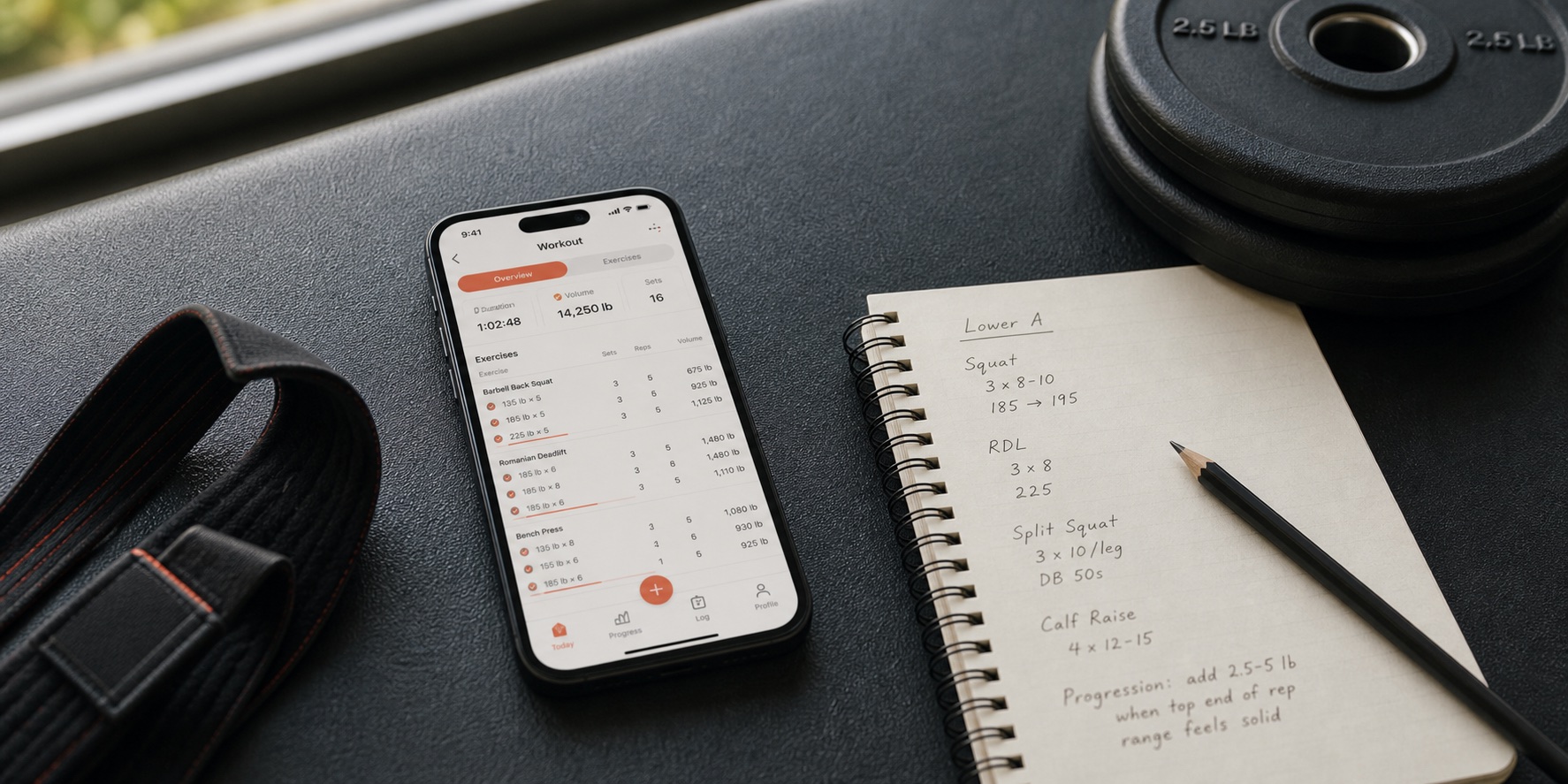
Track:
- exercise
- load
- reps
- sets
- effort or reps in reserve
- notes on form, pain, or unusual fatigue
The goal is not data for its own sake. The goal is to know whether the next session should go up, stay the same, or back off.
How Brace AI is approaching progressive overload
Brace AI is being built around the same coaching logic this guide uses: logged sets should help decide the next target. If a lift moves well, the app direction is to suggest a small load or rep increase. If performance flattens while effort rises, the safer decision may be to hold steady, adjust volume, or make the next session easier.
That is the same principle a good coach uses: look at what actually happened, then make the next training decision.
You should still be able to override the suggestion. The point is not to remove control. The point is to stop guessing every time you open the workout.
The simple checklist
Before you increase load, ask:
- Did I hit the target reps?
- Did form stay consistent?
- Did I recover from the last session?
- Am I progressing one variable, not five?
- Does the next jump match the lift?
If the answer is yes, progress. If not, hold the line and make the next session cleaner.
Founder and editorial lead, Brace AI
Practical strength training guidance reviewed against the product's coaching model and current lifting best practice.
Reviewed by Will Richards , Editorial review
Sources and freshness
Sources were reviewed on June 8, 2026. This guide uses health and exercise-science sources for the principle of progressive overload, then translates that into practical coaching rules for beginners. Exact loading decisions still depend on exercise, technique, recovery, and training history.
Sources
- 01 Cleveland Clinic: progressive overload (Used for the plain-English definition, gradual progression framing, and recovery-aware safety guidance.) health.clevelandclinic.org/progressive-overload
- 02 Mayo Clinic: progressive overload (Used for health-oriented explanation of getting stronger gradually.) sncs-prod-external.mayo.edu/hometown-health/speaking-of-health/progressive-overload-get-stronger-in-a-healthy-way
- 03 PMC: resistance training principles review (Used for resistance-training programming context and adaptation principles.) pmc.ncbi.nlm.nih.gov/articles/PMC9528903
- 04 NSCA: foundations of fitness programming (Used for general programming principles and progression context.) nsca.com/contentassets/8323553f698a466a98220b21d9eb9a65/foundationsoffitnessprogramming_201508.pdf
- 05 Stronger by Science: progressive overload strategies (Used for practical coaching nuance around overload, adaptation, and not over-focusing on load jumps.) strongerbyscience.com/progressive-overload-strategies
- 06 Barbell Medicine: beyond progressive overload (Used to keep the guide careful about adaptation, fatigue, and oversimplified overload claims.) barbellmedicine.com/blog/beyond-progressive-overload