How to Do the Conventional Deadlift
The conventional deadlift is a full-body pulling lift that trains the posterior chain, building the hamstrings, glutes, and back by lifting a loaded bar from the floor.
Updated
Primary muscles
Hamstrings, Glutes, Back
Secondary muscles
Forearms, Core, Traps
Equipment
Barbell
Level
Intermediate
Type
Compound
Typical reps
editorial starting ranges: 3-6 for strength, 6-10 for size
The conventional deadlift is one of the most useful posterior-chain lifts. Picking a loaded bar up from the floor trains the hamstrings, glutes, back, grip, and trunk together, and it teaches a loaded hip hinge when the setup is controlled.
Because it is demanding, the deadlift rewards patience and precision. A tight setup, a braced trunk, and a bar that stays close to your body make the lift more repeatable and easier to progress.
Direct answer: how to deadlift
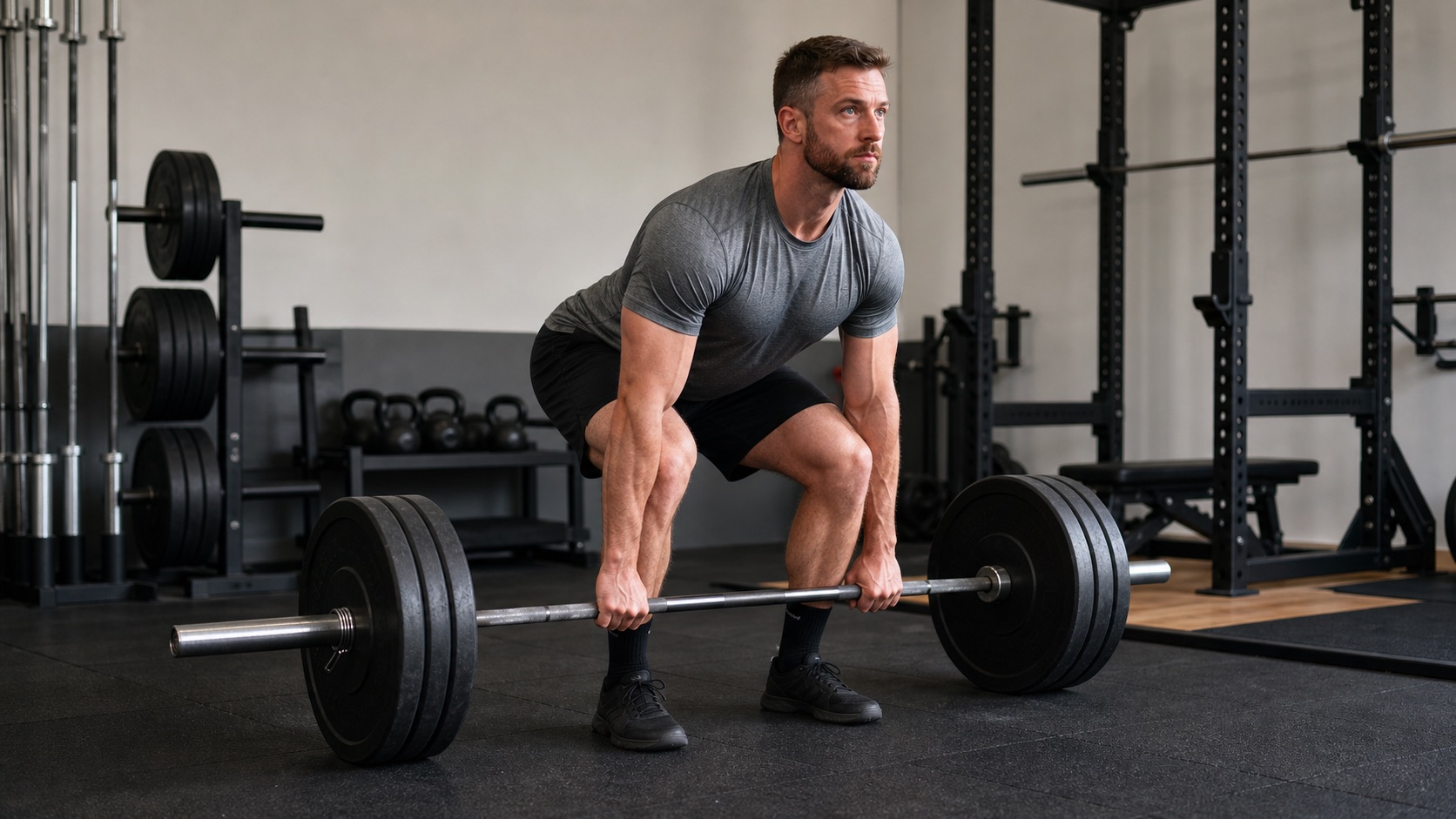
Stand with the bar over your midfoot, hinge down to grip it, bring your shins to the bar, brace hard, pull the slack out, then push the floor away while keeping the bar close. Lock out by standing tall with the hips through, not by leaning back.
Most good conventional deadlift reps have five traits:
- Bar starts over midfoot and stays close.
- Hips are high enough for tension, not squatted too low.
- Back position is braced before the bar leaves the floor.
- The bar breaks from the floor smoothly, not from a jerk.
- Lockout finishes with glutes and legs, not a lower-back lean.
If the bar drifts forward, the hips shoot up early, or the back position changes before the bar leaves the floor, reduce the load and rebuild the setup.
Setup checklist
| Setup point | What to do | Why it matters |
|---|---|---|
| Bar position | Start with the bar over midfoot | Keeps the bar close to your center of mass |
| Stance | Feet around hip width | Lets the arms hang just outside the knees |
| Grip | Grip just outside the legs | Keeps the pull narrow and efficient |
| Shoulders | Start slightly in front of the bar, not behind it | Helps the bar travel vertically instead of swinging forward |
| Lats | Squeeze the armpits down and back before the pull | Keeps the bar close to the body |
| Slack | Pull tension into the bar before it leaves the floor | Prevents jerking and losing position |
| Brace | Big breath and rigid trunk before the pull | Helps maintain position under load |
Do not turn the setup into a squat. The deadlift is a hinge. Your knees bend, but your hips stay back enough that hamstrings, glutes, and back can all contribute.
Source note: Stronger by Science, JTS Strength, and ExRx’s deadlift form guide all emphasize the same core setup ideas: bar close to the body, brace before the pull, and avoid yanking the bar from a loose position.
Body-proportion adjustments
Not every good deadlift setup looks identical. Limb length changes the start position.
| If you have… | What may happen | Useful adjustment |
|---|---|---|
| Long legs and shorter arms | Hips may start higher | Do not force a squatty start; brace harder and keep the bar close |
| Long arms | Hips may start lower and torso may be more upright | Still keep shoulders slightly in front of the bar |
| Limited hip mobility | Back position may change near the floor | Try blocks, a trap bar, or Romanian deadlifts while building range |
| Grip limits | Hands fail before the target muscles | Use straps for hypertrophy work, or learn mixed/hook grip carefully |
The goal is not copying someone else’s hip height. The goal is a repeatable start where the bar stays over midfoot, the back position is braced, and the first inch off the floor does not change your shape.
Muscles worked
The conventional deadlift trains the posterior chain: hamstrings, glutes, spinal erectors, upper back, traps, forearms, and trunk. It is not just a lower-back exercise, and it should not feel like only your lower back is doing the work.
Source note: The muscles-worked description is based on ExRx’s deadlift page, ExRx’s deadlift form guide, and the performance context in the NSCA deadlift article. Those sources support the deadlift as a multi-muscle hinge/pull rather than a lower-back-only movement.
If you mostly feel the lift in the lower back, check whether the bar is drifting forward, your hips are rising too soon, or you are losing your brace before the bar moves.
Programming examples
The ranges below are editorial starting points. The sources support matching load, reps, variation, and fatigue to the training goal; they do not prescribe one universal deadlift frequency or rep scheme.
| Goal | Sets and reps | Rationale and closest source context |
|---|---|---|
| Beginner hinge practice | 2 to 3 sets of 5 | Keep reps crisp and stop before form changes; ExRx and the coaching sources support technique-first setup work |
| Strength | 3 to 5 sets of 1 to 5 | Use longer rests and avoid frequent maxing; NSCA is used for strength/performance context |
| Hypertrophy/accessory | 2 to 4 sets of 5 to 8 | Consider Romanian deadlifts if the floor pull is too fatiguing; ExRx and coaching sources support variation by goal |
| Technique work | 3 to 5 sets of 3 paused or tempo reps | Useful when bar position or bracing is inconsistent; JTS and Stronger by Science are used for technical troubleshooting |
Most lifters do not need heavy conventional deadlifts every session. Treat one hard pull day per week as a conservative starting point, then add lighter hinge work only if recovery and technique stay good. That is coaching guidance, not a universal rule: powerlifting, sport training, hypertrophy blocks, and rehabilitation contexts can all use different frequencies.
Source note: NSCA’s deadlift article supports the deadlift as a serious strength and performance lift, while the ExRx and coaching sources above support using load, reps, and variation according to the goal rather than maxing every session.
Common fixes by symptom
| Problem | Likely cause | First fix |
|---|---|---|
| Bar drifts forward | Bar starts too far away or lats are loose | Start over midfoot and squeeze the bar toward you |
| Hips shoot up first | Starting too low or no leg drive | Let hips start slightly higher and push the floor away |
| Back rounds before the bar moves | Brace is not set or load is too heavy | Reduce load and brace before pulling slack |
| Grip fails early | Hands are the limiter, not posterior chain | Use chalk, straps, or learn mixed/hook grip with care |
| Lockout leans back | Trying to finish with lower back | Squeeze glutes and stand tall without hyperextending |
Troubleshooting should change one thing at a time. If you move the bar closer, change hip height, switch grip, and add straps all at once, you will not know what actually fixed the lift.
Alternatives and variations
| Alternative | Best for | Tradeoff |
|---|---|---|
| Romanian deadlift | Hamstring and hip-hinge volume | Starts from the top and uses less knee bend |
| Trap-bar deadlift | More upright pulling and easier setup for some lifters | Different loading pattern than a straight bar |
| Sumo deadlift | Wide-stance pulling and shorter range for some bodies | More hip and adductor demand |
| Rack pull | Overload or lockout practice | Less floor-start strength and range of motion |
| Kettlebell deadlift | Beginner hinge learning | Limited loading long term |
| Block pull | Learning a better start position or training around range limits | Less range of motion than the floor pull |
| Paused deadlift | Fixing position off the floor | Lower load and higher technique demand |
Choose the variation that lets you keep the bar path, brace, and hinge consistent. The best deadlift variation is the one you can train hard without turning every rep into a recovery problem.
Use a regression when the floor pull is not ready yet. A kettlebell deadlift, trap-bar deadlift, or block pull can teach the hinge and brace with fewer setup demands. Use a progression when the standard lift is good but needs a specific fix, such as paused deadlifts for off-the-floor control or Romanian deadlifts for hamstring and hinge volume.
Safety and troubleshooting
Deadlifts are not automatically bad for your back, but they are unforgiving when load, fatigue, and poor setup stack together. Treat back discomfort as feedback, not something to push through blindly.
Common fixes:
- Move the bar closer before you pull.
- Pull slack out before the bar leaves the floor.
- Use a lighter load while you learn the brace.
- Reset each rep instead of bouncing.
- Stop the set when position changes.
If you have sharp pain, radiating symptoms, or a history of back injury, use professional guidance instead of relying on form cues alone.
Safety source note: The back-pain guidance is deliberately conservative. Physio-Pedia’s deadlift exercise page, Physio Network’s deadlift article for physios, and clinical-leaning rehab sources in the source pack all treat deadlift tolerance as context-dependent. This page should not be read as diagnosis or rehab programming.
How we evaluated this guide
We checked deadlift recommendations against coaching sources, exercise-library references, strength-and-conditioning guidance, biomechanics material, and common lifter troubleshooting themes. The guide avoids absolute safety claims because deadlift usefulness depends on setup, dose, recovery, and the lifter in front of the bar.
Short answer
Use the conventional deadlift when you want a compound lift that trains hamstrings, glutes, back with clear progressive overload. It is most useful when you can keep the setup repeatable, move through a controlled range of motion, and add load or reps without changing the form.
The lift belongs in a program, not as a random challenge. Start with a load you can control, keep a few clean reps in reserve, and progress only when the working sets look the same from first rep to last rep.
Claim-source map
How we picked and source-checked this exercise guide
We separate sourced exercise facts from editorial coaching judgment so the guide is easier to verify, update, and cite.
Setup and technique
The setup checklist, step-by-step cues, bar path, and range-of-motion guidance are practical cues based on the technique references.
- Stronger by Science: how to deadlift (strongerbyscience.com/how-to-deadlift) - Used for deadlift setup, bracing, bar path, and technique context.
- JTS Strength: pillars of deadlift technique (jtsstrength.com/pillars-deadlift-technique) - Used for coaching cues and technical troubleshooting.
- ExRx: deadlift form (exrx.net/Kinesiology/DeadliftForm) - Used for exercise form and movement-pattern context.
Muscles worked
Primary and secondary muscle claims come from exercise-library and biomechanics sources, then are translated into plain English.
- ExRx: deadlift (exrx.net/Kinesiology/Deadlift) - Used for muscles worked and biomechanics context.
- Frontiers: deadlift biomechanics (frontiersin.org/journals/bioengineering-and-biotechnology/articles/10.3389/fbioe.2025.1597209/full) - Used for current biomechanical discussion.
- ExRx: deadlift form (exrx.net/Kinesiology/DeadliftForm) - Used for exercise form and movement-pattern context.
Sets, reps, and progression
Programming ranges are coaching defaults. Use them as starting points, then adjust load, volume, and frequency based on recovery and rep quality.
- NSCA: deadlift application to performance (nsca.com/education/articles/tsac-report/the-deadlift-and-its-application-to-overall-performance) - Used for performance and coaching context.
- JTS Strength: pillars of deadlift technique (jtsstrength.com/pillars-deadlift-technique) - Used for coaching cues and technical troubleshooting.
Safety and troubleshooting
Pain, regression, and mistake guidance is editorial coaching support, not diagnosis or medical advice.
- Physio Network: deadlift article for physios (physio-network.com/blog/best-damn-deadlift-article-physios) - Used for back-pain nuance and coaching context.
- Physio-Pedia: deadlift exercise (physio-pedia.com/Deadlift_Exercise) - Used for conservative exercise and rehabilitation context.
Who this is for
This section is meant to help you decide whether the exercise belongs in your program, not just whether you can perform it once. A good fit means the movement matches your goal, equipment, current skill level, and ability to progress it without losing form.
Best fit
Lifters who want to build hamstrings, glutes, back with a movement that can be tracked and progressed over time.
Not ideal if
You cannot set up the movement consistently yet, feel joint pain during warm-ups, or need a simpler variation to learn the pattern first.
How to progress
Add reps first, then small weight jumps once every set stays controlled. If form changes, hold the load and earn cleaner reps before increasing again.
How to Do the Conventional Deadlift
- 1
Stand with the bar over your midfoot, shins about an inch away, feet hip-width apart.
- 2
Hinge at the hips and grip the bar just outside your knees.
- 3
Drop your hips, lift your chest, and pull the slack out of the bar so your body is tight.
- 4
Push the floor away and stand up, keeping the bar dragging close to your legs.
- 5
Lock out by squeezing your glutes, then hinge back and lower the bar under control.
How to program the Conventional Deadlift
Most lifters should treat the conventional deadlift as a main movement or a serious accessory, depending on their goal and recovery. Use the lower end of the rep range when strength is the priority and the higher end when you want more practice, muscle-building volume, or a slightly easier recovery cost.
A simple progression is to keep the same weight until all working sets reach the top of the rep range with clean technique, then add the smallest practical jump next time. This keeps progressive overload tied to execution rather than ego.
Common conventional deadlift mistakes
- Rounding the lower back instead of bracing and hinging from the hips.
- Letting the bar drift away from the shins, which strains the lower back.
- Jerking the bar off the floor instead of pulling the slack out first.
- Hyperextending or leaning back hard at lockout.
Form tips to get more from it
- Think push the floor away rather than pull the bar up.
- Keep the bar in contact with your legs the whole way.
- Reset your brace and bar position before every rep from the floor.
- Use straps, a mixed grip, or hook grip only when grip is the limiting factor, and learn the tradeoffs before pushing heavy.
Sources and freshness
Sources were reviewed on June 8, 2026. Deadlift advice is highly context-dependent: body proportions, injury history, training goal, and load all matter. This page uses coaching sources, exercise-library references, biomechanics sources, and conservative safety wording.
Sources
- 01 Stronger by Science: how to deadlift (Used for deadlift setup, bracing, bar path, and technique context.) strongerbyscience.com/how-to-deadlift
- 02 JTS Strength: pillars of deadlift technique (Used for coaching cues and technical troubleshooting.) jtsstrength.com/pillars-deadlift-technique
- 03 ExRx: deadlift form (Used for exercise form and movement-pattern context.) exrx.net/Kinesiology/DeadliftForm
- 04 ExRx: deadlift (Used for muscles worked and biomechanics context.) exrx.net/Kinesiology/Deadlift
- 05 NSCA: deadlift application to performance (Used for performance and coaching context.) nsca.com/education/articles/tsac-report/the-deadlift-and-its-application-to-overall-performance
- 06 Frontiers: deadlift biomechanics (Used for current biomechanical discussion.) frontiersin.org/journals/bioengineering-and-biotechnology/articles/10.3389/fbioe.2025.1597209/full
- 07 Physio-Pedia: deadlift exercise (Used for conservative exercise and rehabilitation context.) physio-pedia.com/Deadlift_Exercise
- 08 Physio Network: deadlift article for physios (Used for back-pain nuance and coaching context.) physio-network.com/blog/best-damn-deadlift-article-physios