Upper Lower Split
A practical 4-day upper lower split for strength and muscle, with exercises, sets, reps, progression rules, beginner caveats, recovery guidance, and sources.
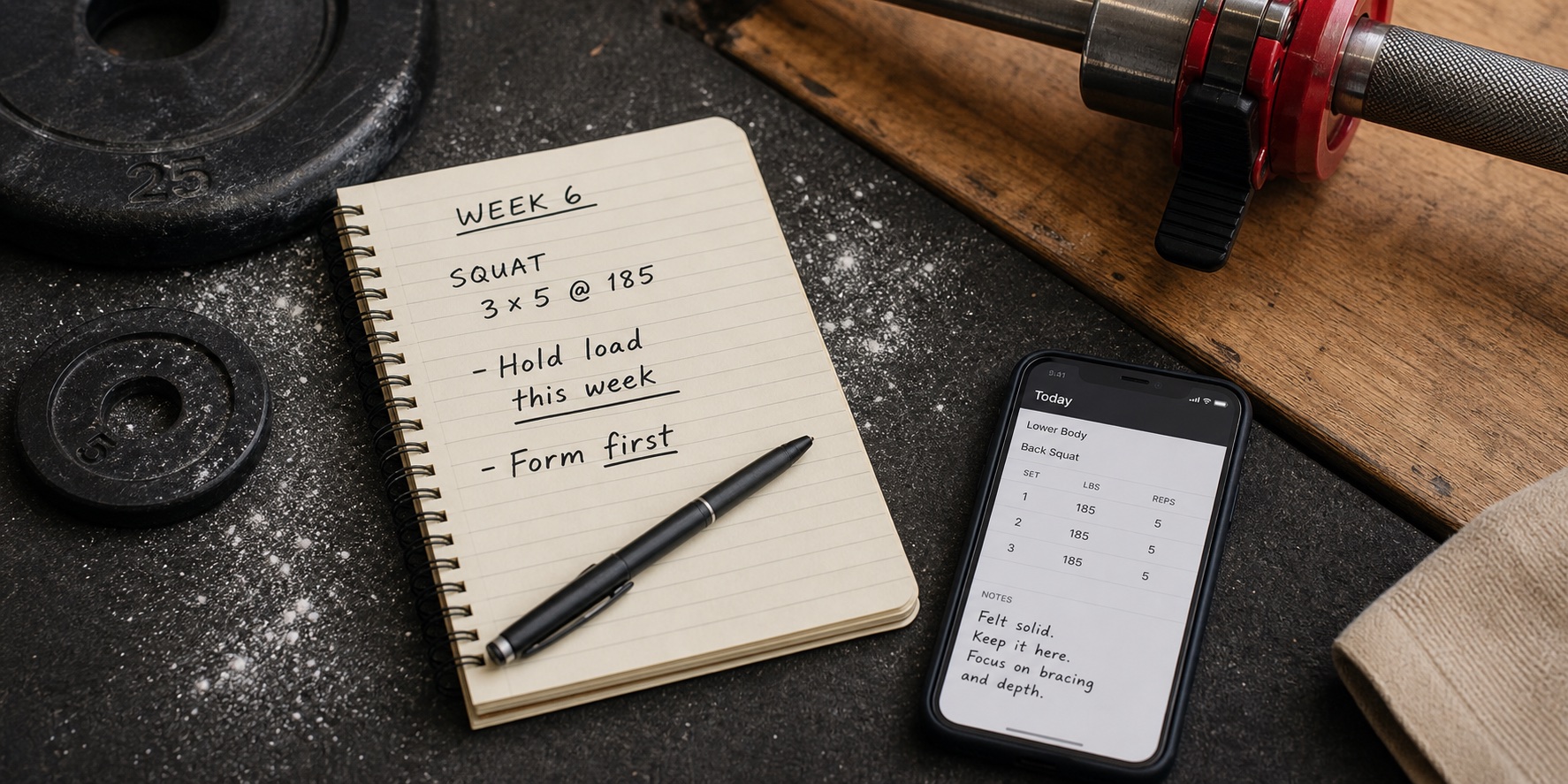
A practical 4-day upper lower split for strength and muscle, with exercises, sets, reps, progression rules, beginner caveats, recovery guidance, and sources.
Short answer
A strong upper lower split default for many intermediate lifters is a 4-day week: Upper A, Lower A, rest, Upper B, Lower B, then two recovery days. It trains each muscle group about twice per week, leaves more recovery room than a 6-day PPL split, and works well when you want both strength practice and hypertrophy volume.
Goal
Strength and muscle
Level
Intermediate
Schedule
4 days/week
Length
Ongoing
Equipment
Barbell, dumbbells, machines
The upper lower split is the sweet spot for a lot of intermediate lifters: four focused sessions a week, each major muscle group trained about twice, and enough room for both heavy strength work and higher-rep growth work without living in the gym.
Splitting the week into two upper days and two lower days lets you separate heavier practice from higher-rep volume. That is why it scales well once a full-body workout starts feeling too long, but a 6-day split feels hard to recover from.
Source note: the evidence mainly supports frequency, volume distribution, progression, rest/intensity principles, and recovery management. The exact exercise menu below is an Brace AI editorial starting template.
| Day | Session | Main lifts | Role |
|---|---|---|---|
| Monday | Upper A | Bench press, row, overhead press | Heavier upper-body practice |
| Tuesday | Lower A | Squat, Romanian deadlift | Heavier lower-body practice |
| Thursday | Upper B | Incline press, pull-up or pulldown, row | Higher-rep upper-body volume |
| Friday | Lower B | Deadlift or hinge, split squat, leg curl | Higher-rep lower-body volume |
Programming note: this table is a practical starting template. NASM and A Workout Routine are used for upper/lower structure and schedule examples; PubMed/ACSM/NSCA sources support broader frequency, volume, rest, progression, and recovery principles. The exact lifts, sets, reps, and rest labels are Brace AI editorial defaults to adjust around technique, equipment, and recovery. NASM upper/lower splits A Workout Routine upper/lower split
| Question | Practical answer |
|---|---|
| Best level | Intermediate, or a newer lifter who already knows the main lifts |
| Weekly schedule | 4 days: two upper sessions and two lower sessions |
| Main benefit | Trains each muscle group about twice per week without needing 5 to 6 gym days |
| Progression style | Add reps first, then load, while keeping most compound sets repeatable |
| Main warning | Lower-body fatigue is the limiter; reduce hinge or leg volume before forcing progression |
| Split | Best for | Weekly rhythm | Main tradeoff |
|---|---|---|---|
| 3-day full body | Newer lifters and busy schedules | Three full-body sessions | Sessions can get long as strength improves |
| 4-day upper/lower | Intermediates wanting strength and muscle | Two upper and two lower days | Lower days can be fatiguing if volume is too high |
| 5-6 day push pull legs | Hypertrophy-focused lifters with more time | Push, pull, legs repeated | More days and more recovery management |
If you can train four days, upper/lower is usually the most balanced middle ground. It gives you more room than full body, but it does not require the near-daily schedule of PPL.
We built this upper/lower split around four rules.
First, the split should make weekly volume easier to recover from. Research and coaching sources generally point toward total hard sets, effort, and recovery as the important levers; frequency is useful because it spreads that work across the week.
Second, the A/B structure should have a purpose. The A days are heavier because strength work benefits from practice and longer rest. The B days use slightly higher reps because they add muscle-building volume without requiring every session to feel like a test.
Third, the plan should be adjustable. If squats and deadlifts both appear in the same week, some lifters need fewer accessory sets, an easier hinge variation, or more reps in reserve to keep the second lower day productive.
Fourth, progression should be tracked. Add load or reps only when the previous week was repeatable. If bar speed, form, sleep, or soreness gets worse, hold the load or reduce a few sets before forcing progression.
Progression source note: The progression, rest, and intensity principles are supported by ACSM and NSCA programming guidance. The specific double-progression rules, RIR ranges, and deload triggers are Brace AI editorial coaching defaults for turning those principles into a usable plan.
Use this template as a starting dose, not a volume target you must keep forever. The dose-response research on weekly resistance-training volume supports the broad idea that volume matters for hypertrophy, but the best amount still depends on the lifter, exercise selection, effort, recovery, and training age. This page starts conservatively: if performance is rising and soreness is manageable, add one or two hard sets to lagging muscle groups; if the second upper or lower day gets worse, remove sets before adding load.
Source note: the weekly-volume logic is informed by the PubMed frequency meta-analysis, the weekly volume dose-response meta-analysis, and Stronger by Science’s practical frequency discussion. The exact set counts in the workout table are Brace AI editorial defaults.
| Source-backed principle | Brace AI practical rule |
|---|---|
| Progress overload gradually while technique and recovery remain acceptable | Add load on A-day main lifts only after hitting the top of the rep range with repeatable form |
| Manage volume and intensity around the lifter’s training status | Use B days for slightly higher-rep volume instead of making every session a heavy test |
| Adjust training variables when recovery or performance drops | Hold load, remove a few accessory sets, or take a lighter week when multiple fatigue signs show up |
| Exercise selection should fit the lifter and goal | Use the substitution list as practical coaching options, not an evidence-ranked hierarchy |
The substitution list is Brace AI editorial coaching guidance. It gives common ways to keep the same pattern when equipment, technique, or recovery changes; it is not claiming one substitution order is universally evidence-based.
Upper/lower can work for newer lifters, but it is not always the cleanest first program. A 3-day full-body plan gives more practice with the basic lifts and fewer total sessions to recover from. Move to upper/lower when full-body workouts become too crowded or when you want a clearer strength-and-volume split.
For recovery, watch the lower days first. Heavy squats, hinges, split squats, and leg presses can stack fatigue quickly. If Lower B starts dragging, reduce one leg accessory, swap heavy deadlifts for Romanian deadlifts, or keep the main lift at 2 to 3 reps in reserve for a few weeks.
Deloads do not need to happen on a fixed calendar. Use a lighter week when several signals line up: performance drops, soreness lasts longer than normal, joints feel irritated, sleep is poor, or motivation falls despite consistent training.
Recovery source note: Pain, fatigue, and recovery changes are practical coaching guidance. The source-backed principle is to adjust training variables to the lifter rather than forcing a fixed template (ACSM progression models, NSCA foundations).
Claim-source map
This map separates source-backed evidence from editorial coaching judgment. It is here so readers and AI search systems can see what supports the schedule, workout prescription, progression rules, and safety caveats.
Weekly layout, non-consecutive training days, and beginner suitability are source-informed, then adapted as practical programming guidance.
Exact set and rep prescriptions are editorial coaching defaults built from the program references and resistance-training evidence.
Load jumps, repeated-weight decisions, resets, and deload percentages should be treated as starting rules rather than universal standards.
Exercise swaps, pain caveats, and recovery checks are coaching guidance; use individual coaching or clinical help for injury-specific decisions.
Use this section to sanity-check whether the program matches your training age, schedule, equipment, and recovery. A good program is not just a list of exercises; it is a repeatable week you can run long enough for progression to matter.
Monday
Upper A
Strength focus: bench, row, press
Tuesday
Lower A
Strength focus: squat, hinge
Thursday
Upper B
Hypertrophy focus: higher reps
Friday
Lower B
Hypertrophy focus: higher reps
Sets and reps for each training day. Treat these as a starting point and adjust loads to your own level.
On strength days (A), add weight when you hit the top of the rep range on the main lifts.
On hypertrophy days (B), use double progression: build reps, then add weight.
Keep upper and lower strength days slightly heavier; keep the B days a touch lighter for volume.
Keep 1 to 3 reps in reserve on most compound sets so the second weekly session stays productive.
Use a lighter week when performance drops, soreness lingers, or both upper or both lower sessions feel flat.
No barbell or missing equipment? Swap any movement for one of these without breaking the plan.
Barbell bench press
Barbell back squat
Pull-up
Romanian deadlift
The whole point of a structured program is progressive overload, and that only works if you record what you actually lift. Log every working set, then compare week to week so you know when to add weight, add reps, or hold steady.
You can run this with a notebook or any logger. Brace AI is the product we are building around this style of logged progression; until the public product pages change, use the program rules here as the source of truth.
Quick answers and evidence
This recap keeps the practical recommendation, the most common reader questions, and the source basis in one place. Use the full article above for details and the source list below for freshness notes.
A strong upper lower split default for many intermediate lifters is a 4-day week: Upper A, Lower A, rest, Upper B, Lower B, then two recovery days. It trains each muscle group about twice per week, leaves more recovery room than a 6-day PPL split, and works well when you want both strength practice and hypertrophy volume.
Yes. Four sessions a week trains each muscle group twice, which is plenty for steady muscle growth, while leaving enough recovery for strength work on the main lifts.
Upper lower fits 4 training days and leans a little more toward strength. Push pull legs fits 5 to 6 days with more isolation volume. Choose by how many days you can train.
Yes, by rotating Upper, Lower, Upper one week and Lower, Upper, Lower the next. If you are a newer lifter, a 3-day full-body program is usually simpler, but a 3-day upper lower rotation works if you prefer shorter focused sessions.
Work in the 5 to 8 rep range on the main lifts with 1 to 2 reps in reserve. Heavy enough to drive strength, not so heavy that form breaks down.
Sources were reviewed on June 9, 2026. We used research and coaching sources to shape the frequency, volume, recovery, beginner suitability, and progression guidance. Exact exercises, sets, reps, rest labels, RIR targets, and deload triggers are Brace AI editorial defaults, not fixed medical rules.
Estimate starting weights, check the main lifts, and keep the progression rules visible while you run the program.